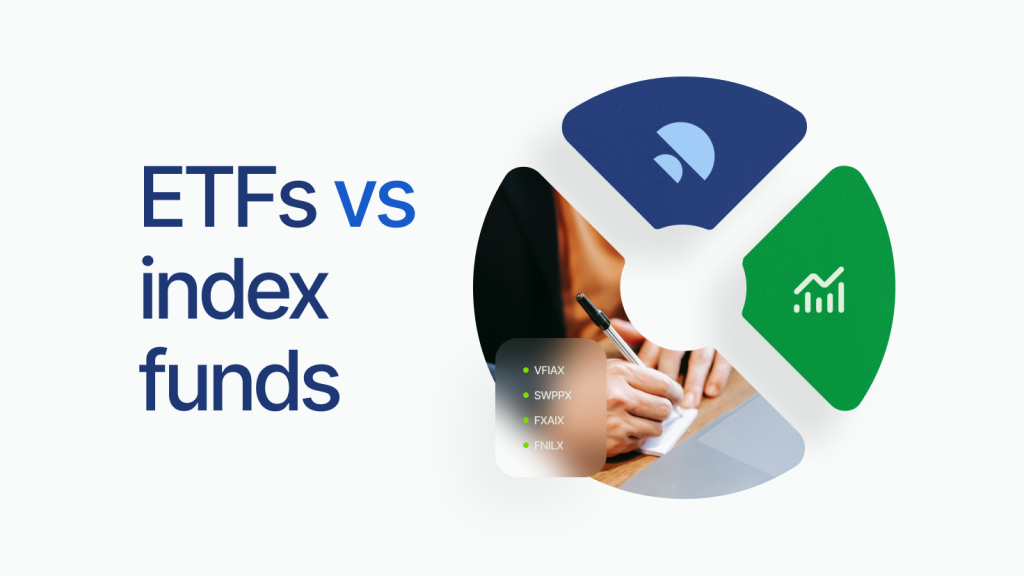
With the evolution of investing, ETF vs Index Fund are two of the most trusted and widely used investment tools. Both provide diversified exposure with low fees and enable long-term growth, making them quite ideal for both a fresher and an experienced investor. However, despite all their similarities, each option has its own unique features that may affect your choice of investing.
To help you decide, let’s explore how the mechanism of operation works between ETFs and Index Funds, what the key differences are, and which one may be the better choice in 2026.
What Are ETF?
These are a type of investment fund that contains a bunch of assets, such as stocks, bonds, and commodities, which are then traded on a stock exchange much like the shares of individual companies.
Key features:
- Traded throughout the day
- Buying and selling at flexible rates
- Often have lower expense ratios
- Able to follow a range of different markets or industries
Because ETFs can be purchased in real time, many investors enjoy the freedom to react immediately to market changes.
What Are Index Fund?
Index funds are types of mutual funds that will follow a selected actual market index, including the S&P 500, Nasdaq, or MSCI World.
Key features:
- Purchased at end-of-day NAV price
- Long-term steady returns
- Minimal maintenance
- Strong diversification
Although Index Funds lack intraday trading flexibility, they are a favorite for the long-term investor who is searching for stability and simplicity.
ETF vs. Index Fund: What’s the Difference?
While both aim to mirror market performance, several distinctions set them apart:
• Trading Flexibility
An ETF is traded throughout the day, whereas index funds are traded only once a day.
They are, therefore, ideal for investors who wish to have more control over timing.
• Costs & Fees
Both usually have very low fees. However, ETFs are actually a little more accommodating in terms of cost, having slightly lower expense ratios and no minimum investment at all.
• Tax Efficiency
This is because, owing to their unique structures, ETFs are more tax-efficient in many countries.
It means long-term investors can retain more of the gains earned.
• Investment Style
Index funds are better for automatic, consistent investing-especially if your platform offers auto-debit contributions.
Investors in ETFs have better flexibility and exposure to the broader market.
Which one will be better in 2026?
Returns are mostly a function of the index each fund tracks.
Still, in 2026 there are several trends that make ETFs a little more attractive:
- Growing ETF categories: AI, green energy, thematic ETFs
- Lower management fees than traditional funds
- Increased interest from the investor community towards flexible, tradable assets
But Index Funds have kept their stability bar high for long-term wealth generation, particularly in retirement planning.
Pros & Cons at a Glance
⭐ ETFs – Pros
- Real-time trading
- Very low fees
- High liquidity
- Large thematic range
⚠ ETFs – Cons
- Prices go up and down all day.
- Can encourage overtrading
⭐ Index Fund – Pros
- simple and predictable
- Perfect for long-term, hands-off investment
- Ideal for dollar-cost averaging
- Lowered emotional decision-making
Index Funds – Cons ⚠
- Less flexibility
- Some funds have higher minimum investment requirements.
Which Is Better for Beginners?
Index Funds are the more comfortable category of investments for beginners seeking simplicity.
But the latter are often more attractive for those who prefer flexibility and lower entry barriers.
Basically: Go with automatic investing and stability, choose the Index Funds. Low cost, real control in any minute, and wider choice: ETFs.
Conclusion
Both ETFs and Index Funds are power tools of wealth creation in the year 2026. Each has its own set of advantages, with the right choice depending upon your style, goals, and risk tolerance. Whether you prioritize flexibility, simplicity, or long-term growth, these investment vehicles offer efficient, low-cost ways to participate in the global markets. Knowing their differences will enable smarter, more confident investment decisions to assist your financial future.